I could’ve chosen any transplanted vegetable for this exercise, but broccoli is just so fun to say repeatedly. Broccoli starts as, yes, a seeds, and gets sown into a plastic cell tray with about 100 of their siblings. After 2-3 weeks of getting watered twice daily their roots begin to get bound up in the little cells. This means it’s time to transplant into the field.
The new bed has already been fertilized, chisel plowed and tilled to prepare for planting. Two rows of little holes are made down the length of the bed at 15 inch spacing with a dibbler. This demarks where the transplants will go. One human walks down the bed, pulling transplants from the cell tray and dropping them near the holes while another human crawls behind on hands and knees, tucking them into the soil. The babies are promptly watered in and blanketed in row cover to protect from cabbage root maggot. Within a few days they are growing new roots down into the soil. Weekly watering ensues, either via sprinklers or drip lines (we use both for broccoli). We hope for not-too-hot of weather, so the plants don’t bolt prematurely.
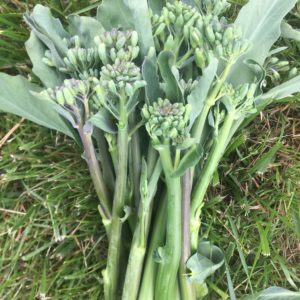 The broccolis usually need to be weeded twice between planting and harvest. The first weeding is often accomplished with the electric Allis Chalmers G tractor, while the plants are small enough to fit between the cultivating knives. After a couple weeks the plants outgrow the tractor’s ability and must be weeded by hand or hoe. When the plants are several weeks old and about the size of a basketball, we remove the row cover as they’re no longer as susceptible to predation by insects. Finally, they begin to “button up”, sending tiny flower buds from their centers, and within 10 days those flower buds have grown into full broccoli heads. Hurray!